Showing posts with label Clybourne Park. Show all posts

Wednesday, September 19, 2012

Review: (Vancouver) Clybourne Park


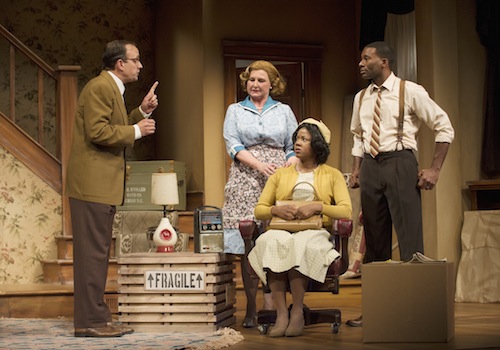
Robert Moloney, Deborah Williams, Marci T. House and Daren Herbert. Photo by David Cooper.

Races in the Park
by David C. Jones

Bruce Norris wrote Clybourne Park, first produced in 2010, in response to Lorraine Hansberry's play A Raisin in the Sun written in 1959 and he, in fact, borrows a character from her play. Norris's Pulitzer- and Tony Award-winning play is a social comedy about race and property values. Act One takes place in the 1950’s and Bev and Russ are selling their home after a family tragedy. Because they sold it to a black family, Karl Lindner (the borrowed character) leads the charge to ‘save’ the all-white neighborhood. Act Two takes place 50 years later and the neighbourhood has become an all black one facing the arrival of a white family. The same actors play different characters but many are related to people from the first act.


Saturday, April 7, 2012

Review: (Toronto) Clybourne Park

Mark McGrinder, Sterling Jarvis and Audrey Dwyer in Clybourne Park. Photo by John Karastamatis.

This Good
Clybourne Park is another dish of brill from Studio 180 Theatre
by Dave Ross


“I wish that every time I went to the theatre, it was this good.” These were the words my fellow CharPo contributor Stuart Munro shared with me as we left the Studio 180 production of Clybourne Park at the Berkeley Street Theatre Downstairs on Friday night. And I absolutely have to agree. 

The play is solely character-driven—there is no waiting for events, no guessing at what will happen next. Act I, set in 1959, introduces us to Bev (Maria Ricossa) and Russ (Michael Healey), a white middle-class couple preparing to move away. This first act begins innocently enough, but as more characters are introduced, we start to get uncomfortable. This climaxes with the arrival of Karl, who is dismayed that a “coloured” couple has been allowed to purchase the house, and his hearing-impaired wife Betsy. Karl is smarmy, but quickly moves from smarmy to reprehensible as he lays out his case for not having a coloured family move into the neighbourhood—all while Bev’s African-American maid Francine and her husband sit in the same room, and are even consulted on how they would feel moving in “next to a bunch of white folk.”  


Sunday, April 1, 2012

Sunday Read: First Person - Joel Greenberg on Clybourne Park

Maria Ricossa (Bev), Audrey Dwyer (Francine) Joel Greenberg (Director) (photo credit: Robert Harding)

Departures
Clybourne Park has an unapologetic approach to uncomfortable issues
by Joel Greenberg

 Studio 180 Theatre is dedicated to plays of social and political purpose. Currently in our 9th season, past productions have addressed homophobia and hate (The Laramie Project), the Middle East (The Arab-Israeli Cookbook), sexual obsession and predatory behaviour (Blackbird), the Rwandan genocide (The Overwhelming), the Bush administration's ramp up to the invasion of Iraq (Stuff Happens), virulent anti-Semitism (Our Class) and the early years of the AIDS epidemic (The Normal Heart). All of these plays have demanded considerable advance research and the rehearsal process itself included a variety of similar tools - film, archival materials, professional speakers, etc.

Clybourne Park, the play we are about to present, is a departure for me. To start, it is a play with a very traditional-seeming structure and setting: the play is set in a modest home that has doors, stairs, windows. All of our past projects have been far less realistic than Bruce Norris' award-winning take on race and real estate in the America of 1959 (act one) and 2009 (act two). Whereas previous productions demanded enormous fluidity between scenes, often using chairs and tables to transform locations in choreographed style, Clybourne Park stays put. Nothing shifts - apart from our sensibilities and attitudes, sparked without warning by the playwright - until intermission when the setting reflects a lapse of 50 years - same house, different world. Clybourne Park is also a play that doesn't invite the degree of advance research typical of earlier projects.

But there is considerable preparation before matters related to staging and research.